
How to choose a statue for a villa entrance
Height, viewing distance, material and lighting: the four things that give a piece presence without overwhelming the space.
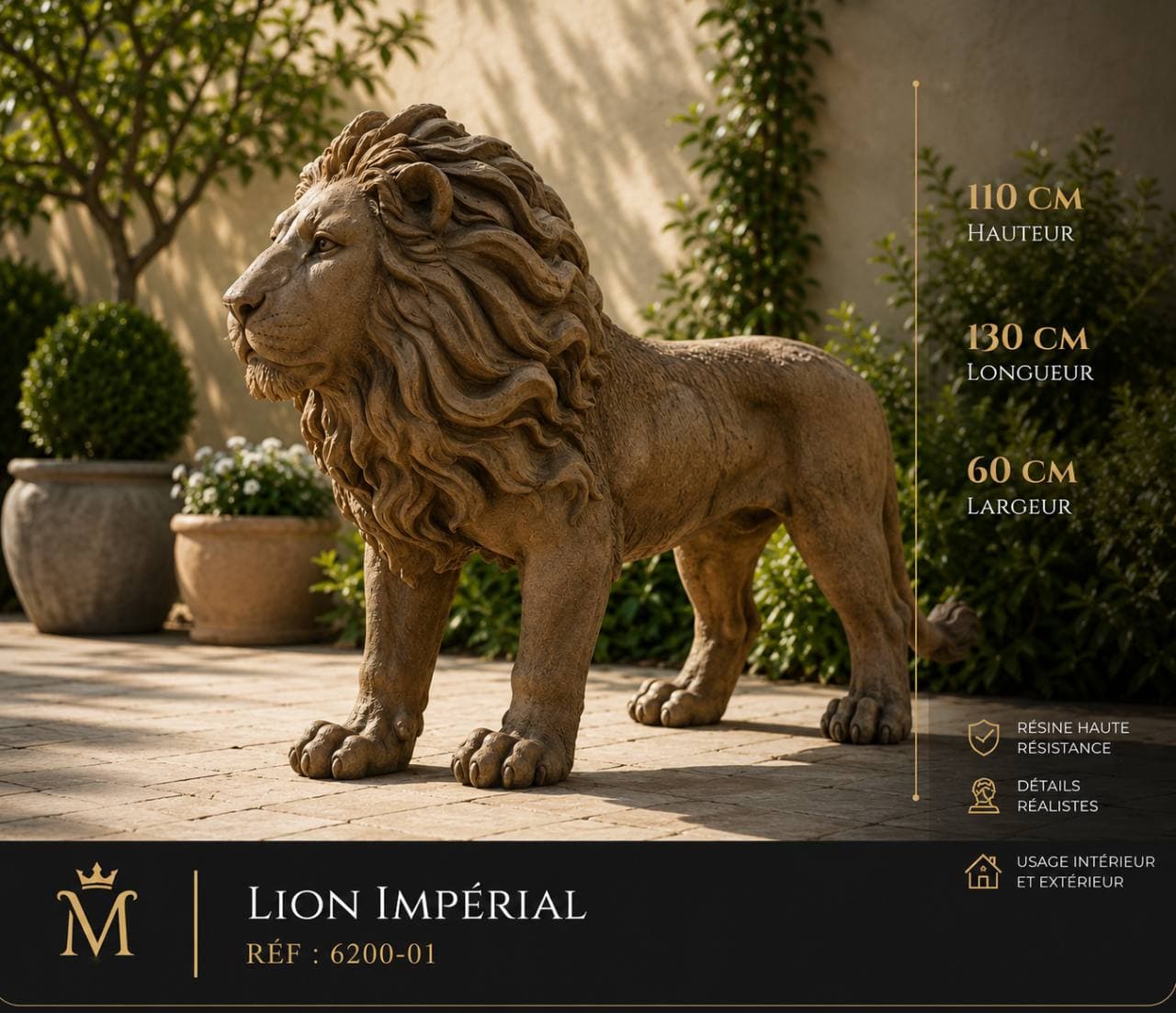
An entrance statue is judged from a distance before it is judged up close. That is the most common mistake: a piece chosen on screen at eye level turns out tiny at the end of a fifteen-metre drive.
The distance rule
Allow roughly one tenth of the viewing distance. A ten-metre drive calls for a piece around one metre; an entrance seen from the road thirty metres away needs two metres or more. Below that, the piece reads as a detail rather than a focal point.
Plinth height matters just as much
A 110 cm lion on the ground and the same lion on a 40 cm plinth do not tell the same story. The plinth lifts the piece clear of planting, protects it from mower spray, and turns it from an object left there into an object presented. On a flat entrance with no level changes, it is the simplest way to create hierarchy.
Choose the finish for the exposure
- Full sun all day: favour light stone finishes, which neither heat up nor fade.
- Shaded and damp: darker or patinated finishes hide moisture marks and green deposits better.
- Poolside or beside a path salted in winter: do not set the piece directly on the ground, a plinth limits contact with de-icing salt.
Lighting transforms the piece at night
A recessed ground spot, fifty centimetres in front of the piece and aimed upward, creates the relief that daylight flattens. After the statue itself it is the most rewarding investment: it doubles the hours the piece is visible.
A pair or a single piece?
Two lions either side of a gate create classical symmetry. A single piece, set off-centre, feels more contemporary and draws more attention. Symmetry needs room: if your two sides measure less than two metres, one piece will sit better.
When in doubt, measure the spot, photograph it from where the piece will most often be seen, and send it to us. We will tell you honestly what volume works.